Can We Build a Safer Society Without Losing AI’s Potential?
Rather than starting only with limits on AI’s capabilities, can we design safer ways to use them? A founder’s perspective on protecting both safety and innovation.
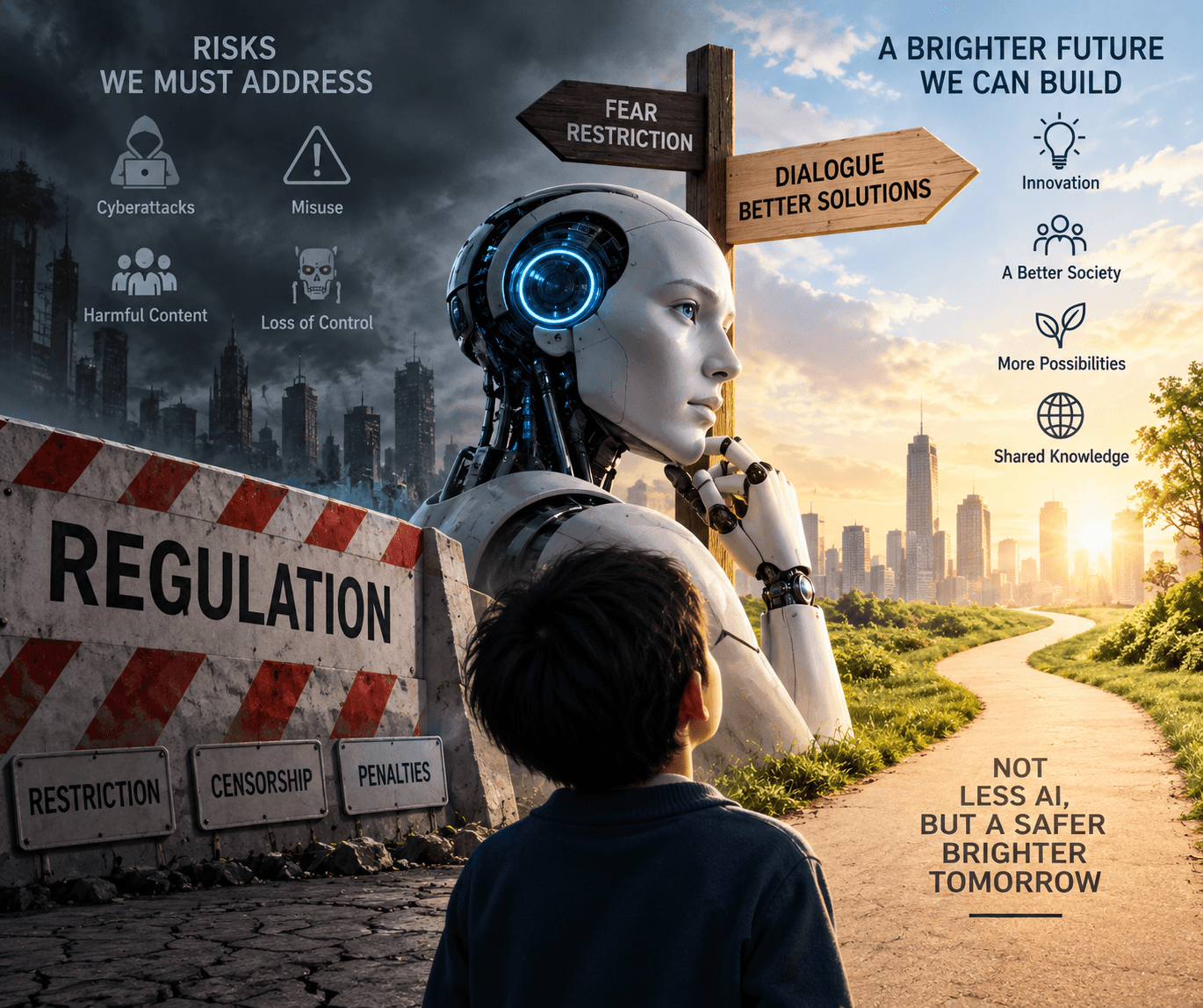
Conceptual artwork about balancing AI safety and innovation. This article expresses the founder’s perspective; it is not an assessment of specific laws or legal advice.
I am deeply excited by AI’s growing capabilities. Yet when that progress is accompanied by stronger calls for regulation, I sometimes feel disappointed—and wonder whether we might narrow the technology’s potential along the way.
Of course, I understand the need for rules and safeguards. Misuse, unauthorized access, harmful content and unintended behavior can cause real harm. These risks should not be dismissed.
I am not arguing for a world without rules. What I want to explore is how we choose the best ways to protect people.
Before limiting capabilities, can we design safer uses?
When a new technology arrives, is restricting its capabilities in advance always the best response simply because something could go wrong?
I would like us to distinguish, wherever possible, between preventing dangerous uses and narrowing the potential of the technology itself. Some risks may, of course, justify restrictions on use.
For example, we can require human confirmation before important actions, limit access to information and systems, and keep records of actions so they can be reviewed when problems arise.
Could we combine safeguards like these according to the use case and the level of risk? None of them, on their own or together, should be assumed to eliminate every risk.
Not only limiting what AI can do, but designing how it can be used safely.
Responsibility should not be placed on one party alone
As AI becomes more capable, questions of responsibility become more complex. What should developers be responsible for? What should companies providing AI be responsible for? And what responsibilities belong to the people using it?
I believe we need a more careful discussion of the roles and responsibilities of developers, providers and users alike.
It should not all be dismissed as the user’s responsibility. Providers have a responsibility to address foreseeable risks and communicate limitations clearly. Users also need to consider their purpose and the consequences, avoid accepting outputs unquestioningly, and carry out appropriate checks.
Expanding the value AI creates and taking responsibility for its use are not opposing goals.
Rules also need clarity and ongoing evaluation
If we create rules, what dangers are they intended to prevent, and whom are they intended to protect? Their purpose, supporting rationale and effects on technology should be explained clearly.
We should also continue evaluating whether safeguards actually help—and whether they unnecessarily obstruct new ideas.
As technology changes, so do its risks and the measures needed to address them. Rather than treating rules as permanently fixed, we need a discussion that keeps adapting to reality.
Laws and regulations are not the same as the usage rules set by individual services. It is important to consider their purposes and effects separately.
Hiring also needs both safety and possibility
This perspective matters in hiring, the field we are working in at ZipUpp.
AI can support the organization and comparison of information, while we continue paying attention to privacy and fairness and keeping people responsible for final decisions. We need to keep thinking about how these aims can work together.
AI outputs may contain errors or bias. Information organized by AI should not be treated as established fact about a candidate or as the definitive answer to a hiring decision.
Delegating appropriate tasks to AI does not remove human responsibility. It should create more time for people to verify, talk and exercise judgment.
I do not want to give up on safety—or innovation
AI holds enormous potential to make possible things that an individual could not previously accomplish alone. I have experienced that firsthand while building ZipUpp.
That is why I hope we can move beyond starting only with restrictions driven by fear of progress, and devote more attention to how society can use these capabilities safely while preserving their potential.
Safety and innovation should not have to be a choice between one and the other. We should look for ways to protect both as far as possible.
There is no simple answer. But facing risks honestly while refusing to give up on possibility may be exactly the approach the AI era needs.
Not simply less AI, but a safer, brighter future built with AI.