How Much Time Is the Recruitment Industry Wasting? What a New Japanese Hiring Survey Reveals
Mynavi’s latest survey reveals inefficiencies in resume screening, mismatched expectations, and job browsing. A ZipUpp founder’s perspective on reducing unnecessary work for employers and candidates.
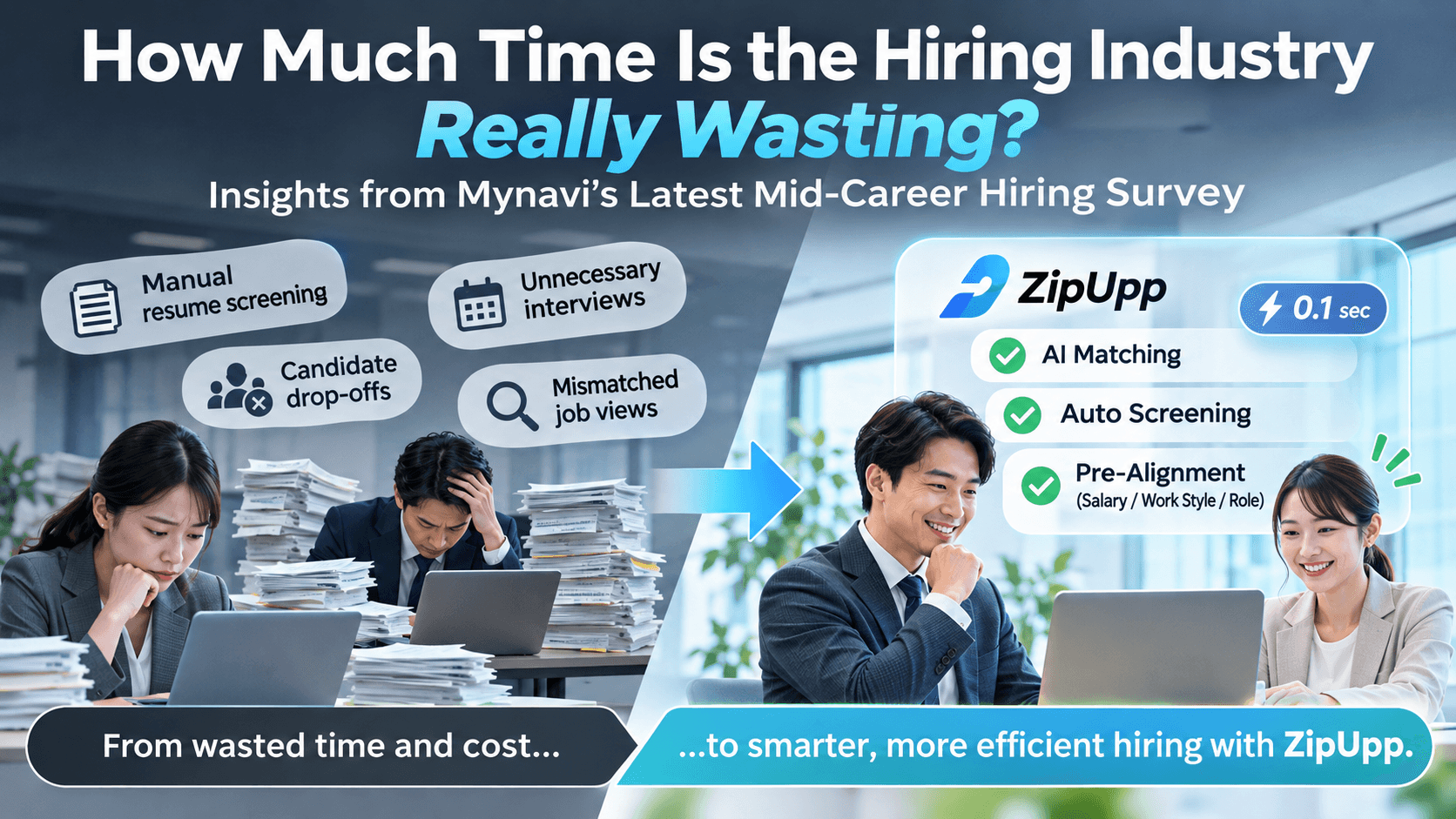
On October 30, 2026, Mynavi released its latest survey on mid-career recruitment and job-seeking activities in Japan.
After reading the results, one thing stood out to me:
Both employers and job seekers are still spending an enormous amount of time on tasks that could be automated.
As the founder of ZipUpp, I found several findings particularly interesting.
1. 36.9 Applicants, but Only 6.4 Hires
According to the survey, the average monthly recruitment figures reported by employers were:
• Applications received: 36.9
• Passed resume screening: 19.1
• First interviews conducted: 14.5
• Final interviews conducted: 9.4
• Job offers made: 7.4
• New hires: 6.4
Comparing applications with hires gives a figure of approximately 17.3%.
In a different dataset I previously examined, there were 73 applicants for every single hire.
That's a significant difference.
Of course, the surveys use different methodologies, so the figures are not directly comparable. The latest survey also reports averages across recruitment activities rather than tracking one group of applicants from beginning to end.
Nevertheless, the numbers raise an important question:
What exactly are recruiters spending their time evaluating?
2. Why Are Humans Still Screening Resumes for Basic Qualifications?
The survey identified the three leading reasons employers rejected applicants during resume screening:
1. Insufficient skills required for the position.
2. Insufficient relevant work experience.
3. Experience level or background did not match the requirements.
My immediate reaction was simple.
Why does a human need to check these things manually?
Required skills, professional experience, and years of experience are all criteria that can largely be compared against a candidate's profile automatically.
This is exactly the kind of work AI should handle.
With ZipUpp, basic matching can be completed in approximately 0.1 seconds, free of charge.
Of course, assessing the quality of someone's experience or their actual capabilities may require deeper evaluation.
But recruiters shouldn't have to spend valuable time manually checking basic eligibility criteria.
Humans should focus on decisions that genuinely require human judgment.
3. Why Are Candidates Rejecting Offers Over Conditions That Could Have Been Checked Earlier?
Another interesting finding concerns why candidates withdraw from recruitment processes or decline job offers.
Leading reasons reported by employers included candidates prioritizing other companies, receiving competing offers, or deciding to join another employer.
Competition for talent is unavoidable.
However, other frequently reported reasons caught my attention:
• Salary expectations did not match.
• Working hours or holidays did not match.
• Job responsibilities did not match expectations.
This raises a fundamental question.
Why are such basic mismatches still being discovered during the recruitment process?
Salary expectations, working hours, holidays, and job responsibilities should ideally be clarified before an interview.
Imagine a recruiter reviewing applications, scheduling interviews, and spending time evaluating a candidate.
The candidate also takes time away from work or personal commitments to attend.
Then, after all that effort, the candidate withdraws because the salary is below their expectations.
If that mismatch could have been identified earlier, much of the effort might have been avoided.
The survey also found that, from the candidate perspective, salary mismatch (24.5%) and job-content mismatch (23.8%) were among the leading reasons for withdrawing around the interview stage.
Naturally, some differences only become apparent through interviews or negotiations.
But basic conditions should be aligned as early as possible.
At ZipUpp, we aim to identify these mismatches through structured profiles and matching criteria before employers and candidates invest time in interviews.
Interviews should be about understanding people, not discovering basic information that could have been checked beforehand.
4. Job Seekers Are Also Wasting Time Browsing Unsuitable Jobs
The survey also examined why job seekers viewed job postings but decided not to apply.
The five leading responses were:
1. Salary did not meet expectations.
2. Job responsibilities were not what they wanted.
3. No particular reason.
4. They believed their skills or experience did not meet the requirements.
5. Benefits or employment conditions did not match expectations.
Notice the pattern?
Salary. Job responsibilities. Skills. Experience. Benefits.
Most of these are factors that could be checked before someone even opens a job posting.
According to the survey, job seekers viewed an average of 23.9 job postings but applied to only 6.1.
That means applications represented roughly one-quarter of the number of postings viewed.
Of course, comparing opportunities is a natural part of job hunting.
But does someone really need to spend time reading a job description when the salary is clearly below their minimum requirement?
Or when they obviously lack a mandatory qualification?
With ZipUpp, candidates can register their skills, experience, and employment preferences in their profiles.
Employers can then identify candidates who match their requirements, while unsuitable opportunities can be filtered out based on the criteria provided.
Instead of browsing dozens of irrelevant opportunities, candidates can focus on those that genuinely fit.
A better recruitment platform shouldn't simply show people more jobs. It should help them find the right opportunities with less effort.
5. Both Employers and Candidates Are Paying the Price
What I found most striking about this survey is that the inefficiency exists on both sides of the recruitment process.
Employers spend time reviewing resumes, checking basic qualifications, arranging interviews, and dealing with preventable mismatches.
Candidates spend time searching through job listings, checking conditions, preparing applications, and attending interviews.
All of this requires time, effort, and money.
Human interaction remains essential in recruitment.
But that doesn't mean every task needs to be performed by a human.
If AI can handle basic comparisons, information gathering, and preliminary assessments, recruiters can focus on evaluating the people who genuinely meet their requirements.
Candidates can also spend less time on opportunities that were never suitable in the first place.
6. What We're Building at ZipUpp
This is exactly why we created ZipUpp.
Our goal is not to replace recruiters with AI.
Nor is it to let AI make final hiring decisions.
Our goal is to automate as much unnecessary human work as possible.
Matching qualifications, checking skills and experience, organizing candidate information, and conducting structured AI interviews are all tasks where technology can dramatically reduce manual effort.
Recruiters should spend their time making important hiring decisions.
Candidates should spend their time exploring opportunities that genuinely match their expectations.
And both sides should avoid unnecessary interviews and repetitive administrative work whenever possible.
The Mynavi survey highlights just how much room for improvement remains in today's recruitment industry.
Of course, the actual time and cost savings delivered by ZipUpp will need to be validated through real-world usage.
But the opportunity to eliminate unnecessary work is substantial.
Recruitment doesn't need more processes. It needs less waste.
That's the challenge we've taken on with ZipUpp.
Source
Mynavi Corporation — September 2026 Mid-Career Recruitment and Job-Seeking Activity Survey, published October 30, 2026.