Banning AI-Generated Resumes Is Pointless. Here's What Really Matters in the Future of Recruitment.
What matters is not who wrote the application, but whether its claims are accurate and what the candidate can actually do.
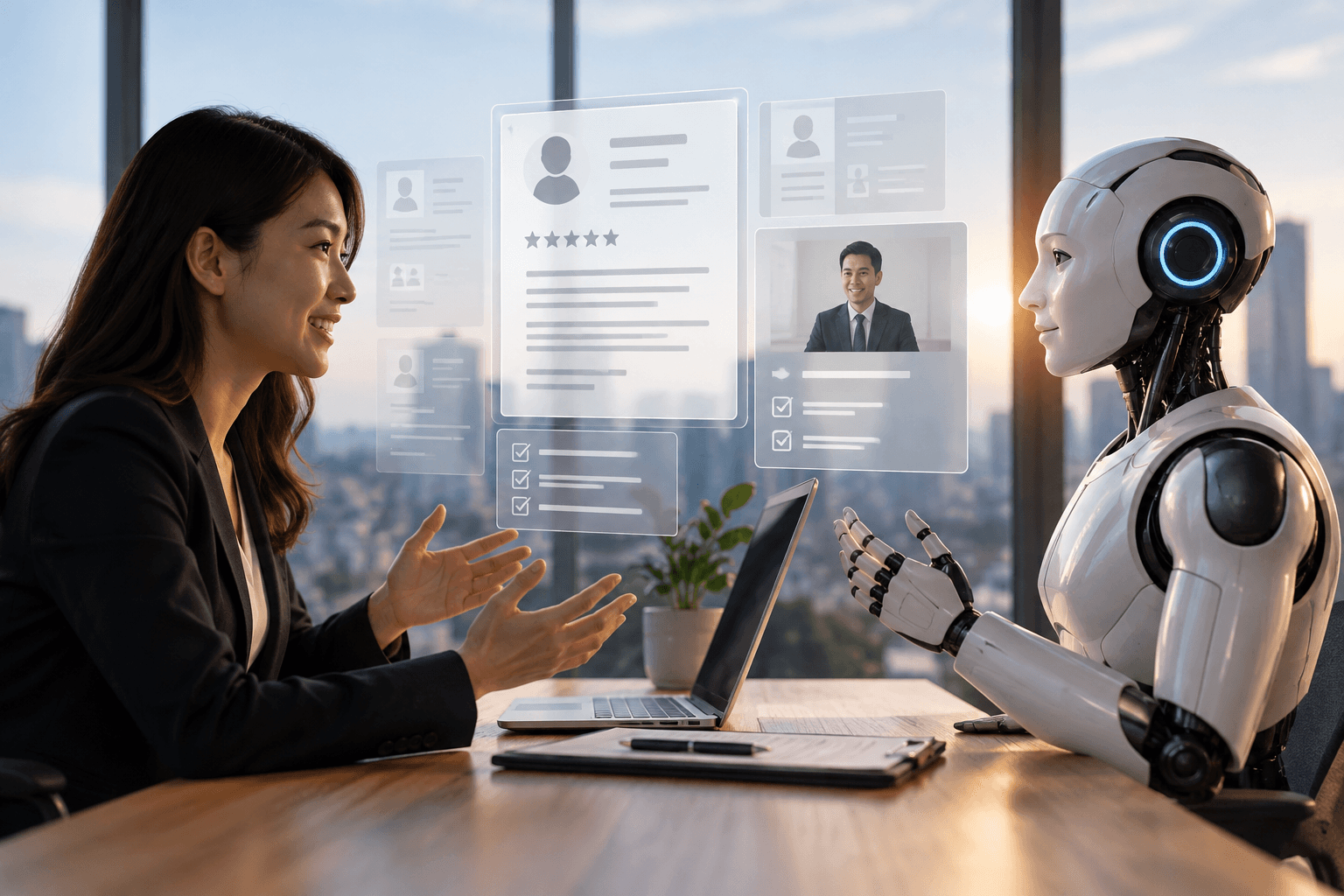
Concept illustration of AI-assisted interviews and information organization, not an actual ZipUpp interface.
I believe companies can no longer stop candidates from using AI to write their resumes and job applications.
These days, using AI to prepare resumes, cover letters, and personal statements is becoming increasingly common.
Yet we still hear discussions about banning AI-generated applications or refusing documents written with AI assistance.
I don't think these restrictions make much sense anymore.
AI is already widely available, and it's going to become even more advanced.
If a company bans candidates from using AI, how exactly does it plan to enforce that rule?
How can an employer reliably determine whether an application was written entirely by a person or created with the help of AI?
I believe making that distinction will become increasingly difficult.
Can Digital Watermarks Solve the Problem?
There's been growing discussion about embedding digital watermarks in AI-generated text to help identify whether content was created by AI.
But I don't believe this will solve the fundamental problem.
What happens if someone takes AI-generated text and makes a few changes?
What if they ask another AI system to rewrite the same content?
Depending on how the watermark works, editing or paraphrasing the text can make it harder to detect.
And even if one AI provider develops a reliable watermarking system, there's no guarantee that every other AI provider will adopt the same approach.
The point is simple.
We cannot realistically prevent people from using AI to write, rewrite, or improve their applications.
Instead of spending time figuring out how to prohibit AI, I think companies should focus on adapting their recruitment processes to a world where AI is part of everyday life.
And there's another question worth asking.
Is using AI to prepare a job application actually a bad thing?
I don't think so.
What matters is not who wrote the application.
What matters is whether the information is accurate and whether the candidate actually has the skills, experience, and abilities they claim to have.
The Days of Judging Candidates by Their Resumes Are Coming to an End
There was a time in Japan when handwritten resumes were the standard.
Employers would look at handwriting, spelling mistakes, sentence structure, and writing style.
Some even believed these details could reveal a candidate's personality, attitude, or ability.
Perhaps those methods had some value at the time.
But things have changed.
Today, someone who struggles with writing can use AI to create an excellent personal statement.
Someone who has difficulty explaining their professional experience can ask AI to organize it into a convincing career history.
And someone with relatively limited experience can still produce an impressive-looking application.
Of course, that doesn't mean people who use AI are lying.
In fact, AI can be extremely helpful for talented candidates who simply aren't good at presenting themselves in writing.
That's a positive development.
But it creates a new problem for employers.
Almost every candidate can now submit a highly polished application.
When everyone has an impressive resume, how much can employers really learn by comparing the quality of those documents?
I believe the value of traditional resume-based screening will continue to decline.
The Real Challenge Is Verifying What's Written
So how should companies evaluate candidates in the age of AI?
I believe the answer lies in verifying the information candidates provide.
Imagine a candidate writes:
"I successfully led a major project and delivered outstanding results."
That sounds impressive.
But did the candidate actually lead the project?
What challenges did they face?
How did they solve those problems?
Were the results primarily due to their own abilities, or were they supported by an experienced team and favorable circumstances?
These are questions that cannot be answered simply by reading a beautifully written resume.
Someone needs to ask questions.
And depending on the answers, someone may need to ask follow-up questions.
The explanations need to be examined for consistency, depth, and credibility.
In my view, the future of recruitment is less about reading what candidates have written and more about verifying the substance behind those words.
But Humans Can't Realistically Do All This Work
This creates another problem.
If recruiters need to verify the experience, skills, and achievements of every applicant through detailed interviews, how much time will that require?
Interviewing a few dozen candidates might be manageable.
But what happens when a company receives hundreds or even thousands of applications?
The amount of time and money required would be enormous.
That's exactly why companies have traditionally relied on resume screening.
They needed a way to narrow down the number of candidates before conducting interviews.
But now that AI can help almost anyone create a polished application, relying on traditional screening methods is becoming less effective.
This is where AI-powered recruitment automation becomes important.
We're already seeing more services that use AI to analyze resumes.
AI interview platforms are also becoming more common.
And these technologies will continue to improve.
However, there's something I find frustrating about the current situation.
One service handles resume screening.
Another handles AI interviews.
A third handles candidate evaluation and comparison.
Recruiters end up switching between multiple platforms, managing information across different systems, and spending time on administrative work that should have been eliminated.
Why does it have to be so complicated?
Why can't the entire process be handled in one place?
What We're Trying to Build with ZipUpp
This is one of the problems we're trying to solve with ZipUpp.
Our goal is to create a platform that can handle the recruitment process from the initial application to identifying the candidates who should be invited for final interviews.
All in one place.
AI can analyze candidates' experience, skills, and professional backgrounds alongside the employer's hiring requirements.
It can help compare how well candidates match those requirements.
AI interviews can then provide additional information that resumes alone cannot reveal.
And all of that information can be organized and presented in a way that makes it easier for recruiters to compare candidates and make informed decisions.
Of course, I don't believe AI can fully understand a human being.
I don't believe AI evaluations are always correct, either.
That's exactly why I think the final hiring decision should remain with humans.
We're not trying to replace human recruiters with AI.
We're trying to create an environment where recruiters can spend more of their time doing the work that truly requires human judgment.
Let Humans Focus on Understanding Humans
I believe recruitment will always involve elements that technology cannot fully replace.
A candidate's personality.
Their values.
Their attitude toward work.
Their ability to collaborate with others.
Whether they are likely to fit into a particular organization's culture.
These things are difficult to evaluate perfectly through AI alone.
And the best candidate for a company isn't necessarily the person with the most impressive resume or the strongest interview performance.
Can they work well with the existing team?
How do they respond when things go wrong?
Are they willing to learn?
Do they share the company's values?
These are questions that deserve genuine human attention.
But if recruiters spend most of their time reading hundreds of applications, arranging interviews, conducting repetitive initial screenings, and managing administrative tasks, how much time do they actually have left for those important judgments?
I think that's a terrible waste of human talent.
Let AI handle the work it can do.
And let humans focus on the work that still requires humans.
I believe this principle applies not only to recruitment, but to many other industries as well.
Recruitment Needs to Change with the Times
Some companies are still discussing whether they should prohibit candidates from using AI to write their applications.
But I think we're asking the wrong question.
Instead of asking how to stop candidates from using AI, we should be asking:
How can companies identify the right people in a world where everyone has access to powerful AI tools?
Resumes will still have value as a starting point.
They provide information about a candidate's background, experience, and qualifications.
But their value as a tool for distinguishing candidates based on presentation and writing quality will continue to decline.
What companies need is a better way to verify the information behind those documents and understand the people who submitted them.
And they need to accomplish that without dramatically increasing recruitment costs or consuming even more of their employees' time.
That's where I believe AI can make a real difference.
From the initial application to selecting candidates for final interviews, all in one platform.
That's the future we're trying to build with ZipUpp.
AI has already changed the way people work, communicate, and create.
Recruitment cannot continue operating as if nothing has changed.
At least, that's how I see it.