Why I Built a Hiring Platform with AI—Without Any Coding Experience
One founder, no employees, and no coding experience. Yet an idea became a working product. This is why I built ZipUpp with AI, and where I hope to take it next.
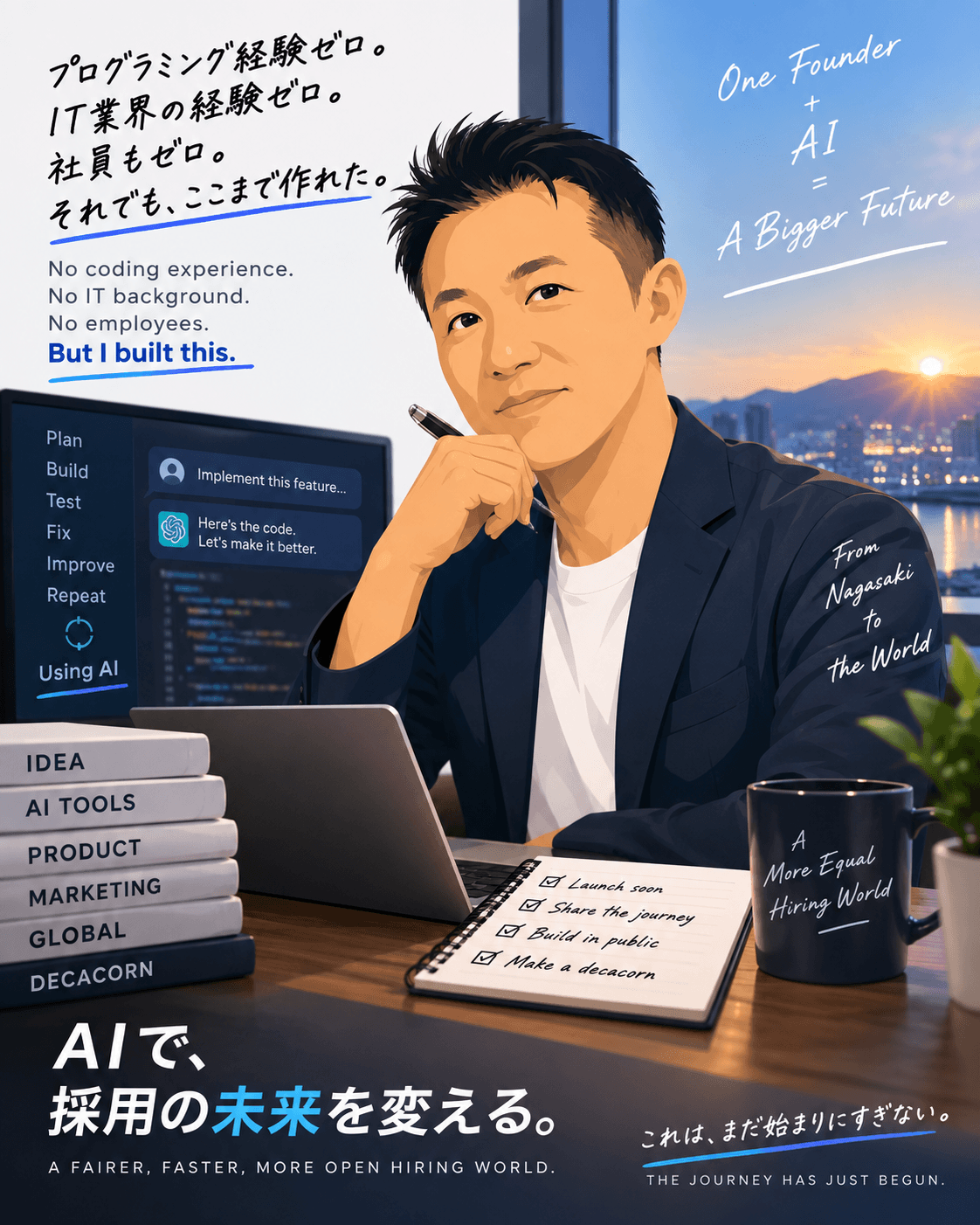
No employees. No coding experience. And yet, I built this.
I am not a programmer.
I have never worked for an IT company or formally studied programming. And the company I am building currently has no employees other than me.
Even so, using AI and Codex, I have built a platform almost from scratch, on my own, to rethink how people find jobs and how companies hire.
That service is approaching launch.
This is not a feature announcement. It is a personal story: why someone who cannot code decided to build a technology company, and what AI has made possible for one person.
I am not an engineer
I do not have the technical skills to write code from scratch and build an entire system. But I knew what I wanted to create.
Hiring still involves considerable inefficiency on both sides. Companies spend money and time finding people, reading résumés, shortlisting candidates, and conducting interviews.
Job seekers search for roles, apply repeatedly, and go through selection processes.
There is also a significant gap between what employers really want to know and the information candidates initially submit.
Could there be a more efficient way?
That question was the starting point for this project.
Telling AI what I want to build
My development process is probably quite different from a typical engineer’s. I start by thinking carefully about what I want to build, then explain it to AI.
What is the purpose of a feature? How will someone use it? What should happen after they press a button? What problems should we prevent?
I describe these things in words and use Codex to implement them.
Then I try the product myself. If something does not work, I fix it. If it is awkward to use, I change it. When an unexpected problem appears, I work through it with AI again.
Think. Build. Test. Break. Fix. Build again.
I have repeated this cycle many times.
I am still not a programmer. But AI has expanded my ability to turn an idea into a working product. A few years ago, that would have been difficult for me to imagine.
AI is expanding who can build
This experience has made AI’s impact very tangible for me. Its value is not simply that it makes work faster.
For people who once thought, “I do not have the expertise,” “I cannot afford to hire engineers,” or “I do not have a large enough team,” AI offers another option:
Try building it yourself.
I believe that is a profound change.
Of course, AI does not solve everything. It makes mistakes. Things do not always work as intended. Sometimes, hours of work end with having to rebuild something entirely.
That makes human judgment more important, not less. What should we build? Why should we build it? Does it genuinely help the user? Those are questions we still need to answer.
The same opportunity exists in hiring
This is where the way I am building the service connects with the service itself.
AI has expanded my own capabilities. What could happen if we brought that same possibility into hiring?
Companies look for candidates. AI helps organize large amounts of information and supports screening.
Personal information is disclosed at the appropriate stage, rather than all at the outset.
AI-assisted interviews can help reveal aspects of a candidate that a résumé alone does not capture.
Employers and candidates can then connect more efficiently.
My ambition is not simply to automate a few recruiting tasks.
It is to redesign how companies and people find one another for the AI era.
Having no employees is not the goal
Right now, there is nobody else employed by this company. But I am not trying to run it alone forever.
As the business grows and needs specialist expertise and an organization around it, I want talented people to join.
What interests me is how AI has changed the starting point for building a company.
Previously, I might have needed to raise money, find engineers, and assemble a team before I could turn the idea into something real.
Now, one person can begin.
Build something. Show it to users. Improve it. Then create the organization when it is genuinely needed.
Through my own company, I am exploring that possibility.
The goal: build a decacorn
I do not intend for this company to remain a small experiment. My ambition is clear.
I am determined to build this company into a decacorn.
Today, we are still at the starting line.
No employees. One founder. And AI.
This began without a large pool of funding or a large development team.
That is why I want to share what happens next openly—not just the successes, but the development failures, the moments when AI did not work as expected, the problems that arose just before launch, and the major changes prompted by user feedback.
I also want to show how I actually build a product with AI.
Before launch and after it, I intend to share as much of the process as I can.
How far can one person plus AI go?
This is a challenge to help change the future of hiring. For me, it is also another kind of experiment:
How far can one person go in the AI era?
No coding experience. No IT background. No employees.
Can that starting point lead to a service used around the world? Can it grow into one of the world’s leading companies?
I intend to find out firsthand.
This is only the beginning.
I hope you will follow the journey, through launch and beyond.