How I’m Building ZipUpp Alone — With Zero Programming Knowledge
No programming background. No engineers on payroll. Building ZipUpp with AI has changed my view of what one person can create—and what a one-person company could become.
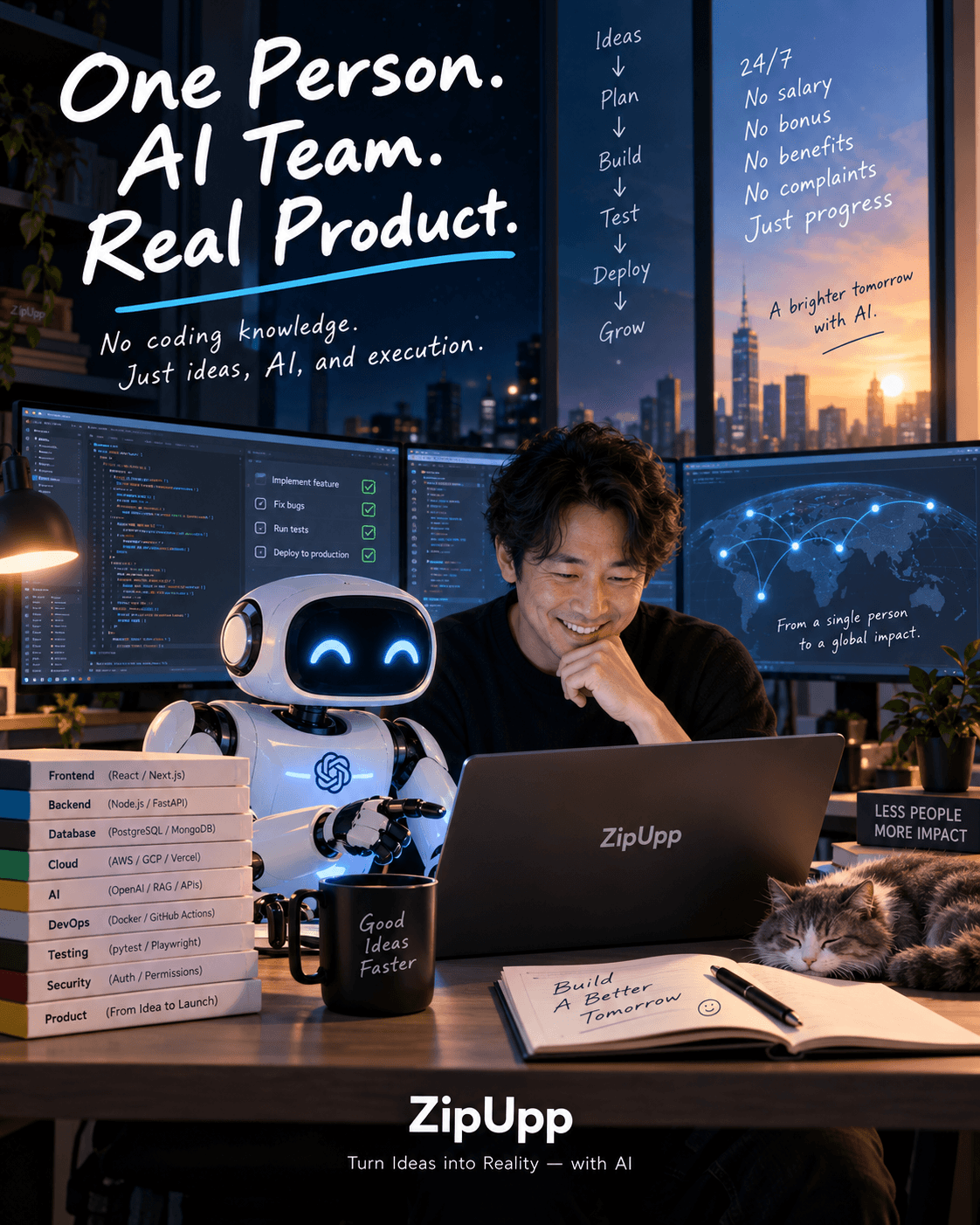
I’m currently building ZipUpp entirely by myself.
I’m not just coming up with the business idea and outsourcing the technical work to engineers.
I’m taking the idea and turning it into requirements and specifications, designing the system, implementing features, testing them, fixing problems, and deploying the product.
Frontend, backend, databases, cloud infrastructure, AI features, security, testing, and deployment — I’m involved in virtually every part of the development process.
There’s just one unusual detail:
I have absolutely no programming background.
Under normal circumstances, building a product like this entirely by myself would be impossible.
AI is what makes it possible.
What Would AI Put on Its Résumé?
Recently, I asked Codex an interesting question:
“If you were applying for a job, what would you put in the self-introduction section of your résumé?”
The answer covered an enormous range of technical capabilities.
Python, TypeScript, JavaScript, and SQL.
Frontend development with React and Next.js.
Backend development with Node.js, FastAPI, and Django.
Databases including PostgreSQL, MySQL, and MongoDB.
Cloud platforms such as AWS, Google Cloud, Firebase, and Vercel.
AI development involving the OpenAI API, RAG, voice processing, and tool integrations.
Then there was Git, GitHub Actions, Docker, automated testing, debugging, code review, security, and deployment.
And beyond coding itself, it could help translate a business idea into requirements and specifications and support the process from architecture through implementation, testing, and release.
Looking at that list, it sounded less like the résumé of one engineer and more like the capabilities of a small development team.
What Would That Team Cost?
So I asked another question:
“What would someone with these capabilities earn in the U.S. employment market?”
The answer I received was around $450,000 in total annual compensation.
Of course, that doesn’t mean AI is literally equivalent to hiring a $450,000 human engineer.
AI and human engineers are not directly interchangeable.
From my own experience, a better comparison is having a small team of perhaps three or four engineers earning around $100,000–$150,000 each, with different areas of specialization.
One for frontend development.
One for backend systems and databases.
One for AI and API integrations.
One for infrastructure, testing, and debugging.
Work that might normally be distributed among several technical specialists can now be coordinated through a single AI system.
But Knowledge Isn’t the Most Surprising Part
What has surprised me most isn’t simply the breadth of technical knowledge.
It’s the speed of execution.
The speed at which AI can write code is extraordinary.
It can generate large amounts of code, examine an existing codebase, make changes, test the results, identify problems, and iterate again.
And it can repeat that cycle extremely quickly.
That’s why I don’t think comparing AI only with the salary of several engineers fully captures its economic impact.
When I consider the breadth of knowledge, speed of execution, and available working hours together, the amount of output I receive feels far greater than a simple salary comparison would suggest.
And It Can Work 24/7
There are also some interesting differences from an employer’s perspective.
No overtime.
No bonuses.
No health insurance or employee benefits.
No paid vacation.
If I want to work late at night or early in the morning, AI is available.
And perhaps one of my favorite advantages:
“This isn’t right. Change it.”
“Actually, put it back.”
“No, this whole approach is wrong. Let’s start again.”
I can say these things repeatedly, and it never complains.
For a solo founder, that makes the working relationship surprisingly stress-free.
AI Is Not the Same as a Human Engineer
None of this means that AI is simply “better than humans.”
Great human engineers bring experience, judgment, creativity, accountability, communication skills, and the ability to make decisions within complex organizations.
Those things matter enormously, and AI does not simply replace them.
What amazes me is something different:
Someone like me, with absolutely no programming knowledge, can now use AI to build a product that previously would have required multiple technical specialists.
I don’t employ a single engineer.
But in a sense, I do have one engineer working with me:
AI.
Except this one can move between frontend, backend, databases, AI, infrastructure, testing, and debugging whenever necessary.
The Meaning of a “One-Person Company” Is Changing
AI is becoming much more than a tool for writing text, answering questions, or making existing work slightly more efficient.
Building ZipUpp has made me realize that AI can expand something much more fundamental:
the amount of execution capacity available to a single human being.
Traditionally, building a company meant raising money, hiring people, and assembling specialists with different skills.
That will still be necessary for many businesses.
But AI may increasingly allow work that once required ten people to be done by five, work that required five people to be done by two, and in some cases, work that required an entire small team to be done by one person.
I’m experiencing that change firsthand while building ZipUpp.
Zero programming background.
Zero engineers on payroll.
Yet I can build a real technology product.
A few years ago, I wouldn’t have imagined this was possible.
Did you know AI could already do this much?
And three years from now, what will the term “one-person company” actually mean?